Mozart's Birthplace Guide
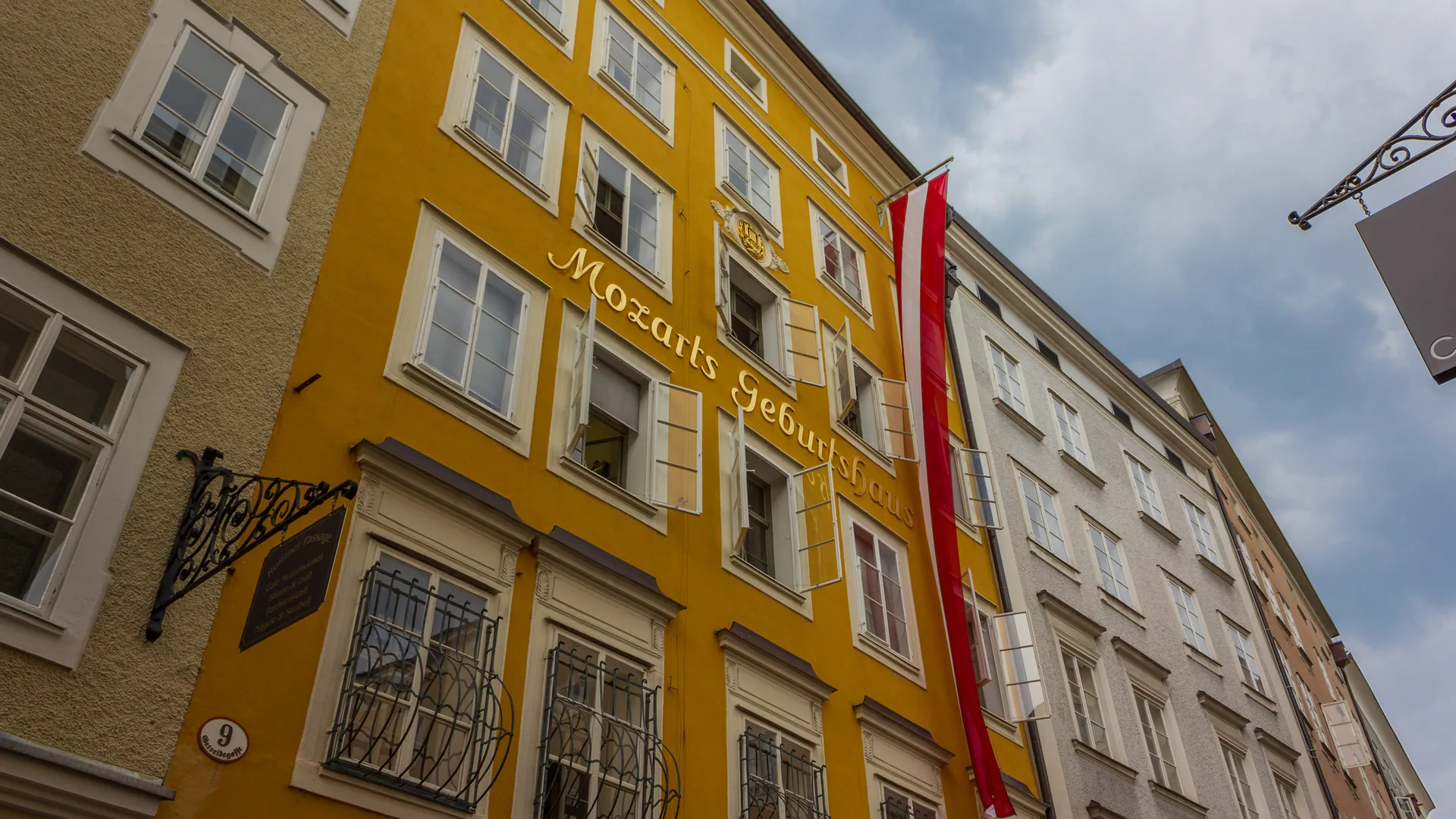
The bright-yellow Getreidegasse 9 townhouse facade in Salzburg lettered “Mozarts Geburtshaus,” with an Austrian flag hanging from it.

Getreidegasse 9 · Salzburg, Austria

Mozart's Birthplace, Salzburg — Plan Your Visit & Experience His City

4.7 (606 verified reviews · GetYourGuide)

On 27 January 1756, Wolfgang Amadeus Mozart was born on the third floor of the bright-yellow house at Getreidegasse 9, where the family lived until 1773. Today that house is a museum spread over three floors, home to his childhood violin, the clavichord on which he composed The Magic Flute, family portraits, handwritten letters and the reconstructed Mozart apartment. It's an inexpensive, walk-up museum — so we're upfront that we don't sell its admission ticket. What we help you plan is the richer, guided way to experience Mozart's Salzburg: a top-rated Old Town walking tour that ties together his birthplace, the UNESCO-listed baroque centre and the Mirabell Gardens, plus the city's famous Mozart concerts in settings where he actually performed. We're an independent booking and planning guide — not the museum or the Mozarteum — so we point you to the museum's own door ticket for the house itself, and every experience we list around it is booked securely through GetYourGuide.

From A$44 Final price in your currency — no hidden fees.

The address itself

The house where Mozart was born

The power of Getreidegasse 9 is that nothing about it is symbolic. Wolfgang Amadeus Mozart was born here on 27 January 1756, on the third floor of what was then the Hagenauer Haus, named for the merchant family who owned it and rented the apartment to the Mozarts from 1747 until 1773. His father Leopold was a court musician and celebrated teacher; his older sister Maria Anna — Nannerl — was a keyboard prodigy in her own right; and the household the visitor walks through was a working musical enterprise long before Wolfgang made it immortal. The house has been open to the public as a museum since 1880 and is today run by the International Mozarteum Foundation, which keeps the emphasis firmly on authentic objects over theme-park recreation.

Getreidegasse 9 is one of the most recognisable addresses in the classical-music world. The tall, narrow, butter-yellow house — historically the Hagenauer Haus, after the family friend and landlord who owned it — is where Wolfgang Amadeus Mozart was born on 27 January 1756, on the third floor, into a household already steeped in music. His father Leopold was a respected court musician and teacher, his sister Nannerl a gifted keyboard player, and the family occupied the apartment here from 1747 until they moved across the river in 1773. Since 1880 the house has been open to the public as a museum, and it remains the single most-visited sight in Salzburg, tucked among the wrought-iron guild signs and boutiques of the Old Town's most famous street.

One house, three chapters

Three floors, three Mozarts

  1. The apartment he was born in

    The tour starts on the third floor, in the modest rented apartment Leopold Mozart took in 1747: a kitchen, a small storage room, a living room, a bedroom and a study. The kitchen sits apart from the living rooms, kept separate so its smoke and fire risk stayed away from the family's living space. A family tree in the hallway lays out the Mozart lineage, a blunt reminder of how many of Leopold and Anna Maria's seven children died in infancy. The storage room holds a genuinely moving artefact: Leopold's letter to his publisher announcing Wolfgang's birth on 27 January 1756. This is the room-by-room start of the museum's own route, not a reconstruction elsewhere in the building.

  2. Mozart and the theatre

    The second floor turns to opera. Its centrepiece room holds the well-known unfinished 1789 portrait of Mozart at the piano, painted by his brother-in-law Joseph Lange — only the head, shoulders and hands are properly worked up, the rest of the canvas left bare, and 19th-century attempts to complete it were abandoned. In the same room sits an original instrument, Mozart's clavichord, on which he is understood to have composed parts of The Magic Flute. Around it are playbills from Mozart opera premieres and costume designs for The Magic Flute's first production, giving a concrete sense of how these works actually reached the stage rather than existing only as scores on a page.

  3. Daily life and the fortepiano

    The first floor steps back from Mozart the composer to ordinary 18th-century domestic and travelling life. One room traces his years on the road with a wall map of his major destinations, his travelling tea caddy and sugar jar, and jewellery given to him as gifts along the way. A second room covers everyday life in Salzburg, from playing cards Leopold painted himself to a blood-letting scarificator, the era's routine medical tool. The route ends in a reconstructed middle-class living room built around period Hagenauer-family furnishings and a fortepiano made by Anton Walter around 1790 — the type of instrument Mozart himself favoured and played on in Vienna in the last decade of his life.

Read the full floor-by-floor tour →

The people behind the address

The family who lived here

Leopold Mozart, a violinist and composer employed by the Salzburg court, married Anna Maria Pertl on 21 November 1747. Shortly after, the couple rented rooms on the third floor of the building at what is now Getreidegasse 9, owned by the Hagenauer family, who were also Leopold's landlords and friends. The apartment was modest — a kitchen, a small storage room, a living room, a bedroom and a study — hardly grand, but centrally placed on Salzburg's main commercial street. Leopold and Anna Maria would raise their family in these rooms for the next 26 years, a period that happened to cover the entire childhood of their most famous son.

Anna Maria bore seven children in the Getreidegasse apartment between 1747 and 1756. Only two survived infancy: Maria Anna, always known as Nannerl, born in 1751, and Wolfgang Amadeus, the youngest, born on 27 January 1756. Child mortality this severe was common across 18th-century Europe, not a mark of particular misfortune for this one family — but it's still the context in which the household actually lived, day to day, for those nine years: every pregnancy a real risk, every surviving child valued and watched accordingly. A family tree displayed in the apartment's hallway sets out the pattern plainly. It's part of why Leopold, once he recognised his two remaining children's musical gifts, invested so heavily and so early in developing them, rather than treating music as an ordinary accomplishment.

Nannerl was, for a period in the 1760s, as celebrated a performer as her younger brother — the pair toured together as child prodigies, presented at courts across Europe by Leopold. As she reached marriageable age, convention closed off the touring and composing career that stayed open to Wolfgang; she continued teaching piano in Salzburg and later married a magistrate, largely stepping back from public performing life. She and Wolfgang stayed close correspondents into adulthood — several of the letters displayed in the museum's later rooms, including one describing his gruelling Vienna schedule, were written to her. Her own musical talent is well documented but never got the same room to develop.
Read the Mozart family story →

Mozart's Birthplace at a glance

Mozart's Birthplace at a glance

27 Jan 1756Mozart was born on the third floor at Getreidegasse 9; the family lived here until 1773
3 floorsThe museum spreads over three floors — childhood violin, clavichord, portraits, letters and the family apartment
Since 1880The house has been open as a Mozart museum, run today by the International Mozarteum Foundation
Walk-up ticketThe museum sells an inexpensive entry ticket directly at the door — no guided tour or third-party ticket needed to go in

Being honest with you

Beyond the house: Mozart's Salzburg

On 27 January 1756, Wolfgang Amadeus Mozart was born on the third floor of the bright-yellow house at Getreidegasse 9, where the family lived until 1773. Today that house is a museum spread over three floors, home to his childhood violin, the clavichord on which he composed The Magic Flute, family portraits, handwritten letters and the reconstructed Mozart apartment. It's an inexpensive, walk-up museum — so we're upfront that we don't sell its admission ticket. What we help you plan is the richer, guided way to experience Mozart's Salzburg: a top-rated Old Town walking tour that ties together his birthplace, the UNESCO-listed baroque centre and the Mirabell Gardens, plus the city's famous Mozart concerts in settings where he actually performed. We're an independent booking and planning guide — not the museum or the Mozarteum — so we point you to the museum's own door ticket for the house itself, and every experience we list around it is booked securely through GetYourGuide.

The birthplace is best enjoyed as part of a wider Mozart itinerary, because Salzburg makes that easy. The whole Old Town is a UNESCO World Heritage Site — a remarkably intact baroque townscape of squares, churches and lanes — and it's a short, atmospheric walk from Getreidegasse to the cathedral, the Residenzplatz and up to the Hohensalzburg fortress. Across the river, the Mirabell Palace and Gardens, also part of the UNESCO listing and beloved by Sound of Music fans, hold the Marble Hall (Marmorsaal), one of the very rooms where the young Mozart performed. A guided Old Town and Mirabell walk connects these threads with a storyteller's eye, which is why it pairs so well with a self-guided hour in the museum.

4.7 · 606 verified reviews · From A$44

See the guided Old Town, Mozart & Mirabell walk ↗

Every route ends on foot

Getting to Getreidegasse 9

Getreidegasse 9 sits inside a pedestrian zone, so however you arrive in Salzburg the last stretch is always on foot. Here is how the trolleybuses, the riverside walk, the car parks and a day trip from Munich or Vienna actually work.

By trolleybus from the Hauptbahnhof

The Mozarteum Foundation's own directions name two useful stops. Trolleybus lines 1, 4, 7, 8, 10, 23, 24, 27 and 28 all serve Hanuschplatz, which sits by the river just outside the Getreidegasse; lines 1, 8, 10, 23, 24 and 28 also stop at Herbert-von-Karajan-Platz at the western end of the lane. Either way you finish with a short, level walk: from Hanuschplatz you cut through one of the arcaded passages into the Getreidegasse, and from Herbert-von-Karajan-Platz you simply walk along the lane until the yellow house appears. Services from the station area are frequent through the day, and both stops put you closer to the door than any car can get.

On foot through the Old Town

Salzburg's centre is compact, and many visitors simply walk from the station or their hotel. The classic approach passes the Mirabell Gardens on the right bank, crosses the Salzach on a footbridge, and drops you almost opposite the entrances to the Old Town lanes — a route that doubles as sightseeing, since the gardens and the river panorama of domes and fortress are two of the city's signature views. Walking also solves the one-way systems and pedestrian-zone barriers that make driving to the museum impossible. If you are pairing the Birthplace with the Mozart Residence on Makartplatz, the two houses sit on opposite banks of the same stretch of river, so a walking loop across the bridges links them naturally.

By car — garages, not gates

You cannot drive to the museum — the Getreidegasse is a pedestrian zone. The Foundation's visitor information points drivers to the Altstadtgarage A/B, the garage complex built into the Mönchsberg rock on the Old Town side, from which it is roughly a seven-minute walk to the Birthplace. If your day also includes the Mozart Residence, the Mirabellgarage on the right bank is the equivalent option there, again about seven minutes on foot. On busy summer days the garages absorb most of the pressure, but the approach roads into the Old Town can still queue, so arriving before mid-morning is the low-stress play if you are committed to the car.

Day trip from Munich or Vienna

Salzburg sits on the main rail axis between Munich and Vienna, and direct trains run to Salzburg Hauptbahnhof from both cities through the day — check Deutsche Bahn or ÖBB for current timetables rather than trusting remembered journey times, especially when engineering works are posted. The museum itself takes about an hour to see, which is exactly what makes it such a reliable day-trip anchor: even with a relaxed lunch, the Getreidegasse, and a river walk added, the whole visit fits comfortably between a mid-morning arrival and an early-evening train home. From the station, the trolleybus stops above get you to the Old Town quickly if you would rather save your walking for the lanes themselves.

Read the full getting-there guide →

Reserve your date

Book the guided Mozart & Old Town walk

The walking tour and the evening concerts are bookable through GetYourGuide, with live availability and the final price shown in your own currency before you pay. The museum's own door ticket stays separate — you buy that at Getreidegasse 9.

Live availability and pricing from GetYourGuide, shown in your own currency.

Check dates & availability ↗
  • Cancellation terms upfront
  • Choose your date & time

Plan every detail

In-depth Salzburg guides

Trolleybuses, garages and a pedestrian lane

Getting to Mozart's Birthplace: Trains, Buses & Parking

Getreidegasse 9 sits in a pedestrian zone, so every route ends on foot — here's how trolleybuses, garages and trains work, plus day trips from Munich or Vienna.

Read guide →
The apartment on the third floor

Mozart's Childhood Violin & the Rooms He Was Born In

The Mozarts lived at Getreidegasse 9 from 1747 to 1773, and the house still holds instruments Wolfgang played — what you're really looking at, floor by floor.

Read guide →
Hours, the combined ticket and a one-day route

Planning Your Visit: Birthplace, Residence & One Full Day

Opening hours, closure dates, the two-house ticket, and bag and photo rules — how to build a full Mozart day around a museum that takes about an hour to see.

Read guide →
Inside Getreidegasse 9

Mozart's Birthplace: A Floor-by-Floor Tour

What's actually on display across the three floors of the house where Mozart was born, room by room — so you know exactly what you're looking at before you go.

Read guide →
The people behind the house

The Mozart Family Story at Getreidegasse 9

Who actually lived in this house, for how long, and why a cramped third-floor rental in Salzburg's old town still matters so much to music history today.

Read guide →
Planning both museums

Combined Tickets & the Salzburg Mozart Trail

Two different Mozarts, one exhibition worth planning around: the Residence's Magic Flute show, and the walk that links both houses across the river.

Read guide →

Good to know

Questions about visiting Mozart's Birthplace

Do I need a ticket for the birthplace museum, and can I buy it here?

You do need a ticket to go inside, but it's an inexpensive standard admission you buy directly at the museum door on Getreidegasse 9 — it rarely sells out, so there's no need to book ahead or pay a third party. We don't sell that entry ticket, and we'd rather say so plainly. What you'll find on this page are guided walking tours that take in Mozart's Salzburg and the city's Mozart concerts, all booked through GetYourGuide.

What's the difference between the Birthplace and the Residence (Wohnhaus)?

They're two separate Mozart museums in Salzburg. The Birthplace, at Getreidegasse 9 in the Old Town, is the yellow house where Mozart was born in 1756 and where the family lived until 1773 — it's strongest on his childhood, his early instruments and personal items. The Mozart Residence (Wohnhaus), across the river on Makartplatz, is where the family lived from 1773 to 1787; it's more spacious, tends to be quieter, and is wheelchair accessible, where the historic Birthplace is not. A combined ticket lets you see both within a set window if you want the full picture.

Are Mozart concerts in Salzburg worth it?

For most Mozart-minded visitors, yes. The Salzburg Palace Concerts in the Marble Hall of Mirabell Palace — a room where Mozart himself performed — and the dinner concerts at Hohensalzburg fortress are intimate, atmospheric evenings of his music, quite different from the grand summer Salzburg Festival. Hearing his work played live in the city that shaped it is, for many people, the most memorable part of the trip. Seats are limited and popular dates sell out, so booking ahead is wise.

Was Mozart really born in this house?

Yes. Wolfgang Amadeus Mozart was born on 27 January 1756 on the third floor of the house at Getreidegasse 9, then known as the Hagenauer Haus. His family lived there for years, until 1773, and the building has been open as a Mozart museum since 1880. It's the genuine article, in the heart of Salzburg's Old Town, not a reconstruction elsewhere.

What can I see inside Mozart's Birthplace?

Over three floors you'll find Mozart's childhood violin, made by Salzburg luthier Andreas Ferdinand Mayr, a clavichord associated with the composition of The Magic Flute, historical fortepianos, the well-known Mozart family portrait, handwritten family letters and early scores, and a reconstruction of the family apartment with period furnishings. One floor focuses on his fascination with opera. It's an intimate collection of authentic objects in the rooms where he grew up.

How long does a visit to the museum take?

Most visitors spend around an hour to ninety minutes inside. It's a compact, densely packed museum rather than a huge one, so you can take it in comfortably in a morning or afternoon and still have time for a guided Old Town walk or an evening concert. If you're combining it with the Mozart Residence across the river, allow a couple of hours in total plus the short walk between the two.

What are the opening hours?

The museum is generally open daily, roughly 9:00 to 17:30, with last admission about half an hour before closing. In July and August the hours usually extend to around 8:30 to 19:00. These are the museum's own hours and can change seasonally or around special dates, so reconfirm on the International Mozarteum Foundation's channels before you visit.

Where exactly is Mozart's Birthplace?

It's at Getreidegasse 9, on Salzburg's most famous shopping street in the heart of the UNESCO-listed Old Town. Look for the tall, bright-yellow building with 'Mozarts Geburtshaus' lettering above the shopfronts — it's one of the most photographed facades in the city and hard to miss once you're on Getreidegasse.

Is the museum wheelchair accessible?

Unfortunately not — the historic house at Getreidegasse 9 cannot be made wheelchair accessible for architectural reasons. If accessibility is important, the Mozart Residence (Wohnhaus) on Makartplatz, the family's later home, is wheelchair accessible and covers much of the same Mozart story with a strong collection of instruments.

What does the Old Town, Mozart and Mirabell Gardens walking tour cover?

It's a guided walk through Salzburg's UNESCO-listed baroque Old Town that ties the Mozart sights together — passing and contextualising his birthplace on Getreidegasse — and crosses to the Mirabell Palace and Gardens, themselves part of the World Heritage listing and famous from The Sound of Music. A guide brings the streets, squares and Mozart connections to life in a couple of well-paced hours. Exact route and inclusions are shown on the listing when you book.

Can I combine the birthplace with the Mirabell Gardens and Old Town in one day?

Easily. The birthplace, the Old Town and the Mirabell Gardens are all within a comfortable walk of one another, on opposite banks of the Salzach river. Many visitors see the museum on their own in the morning, join a guided Old Town and Mirabell walk, and cap the day with an evening Mozart concert — a full, satisfying day of Mozart's Salzburg without ever needing a car.

Is Salzburg's Old Town a UNESCO World Heritage Site?

Yes. The historic centre of Salzburg is a UNESCO World Heritage Site, recognised for its exceptionally preserved baroque townscape. Mozart's Birthplace sits right in the middle of it, and the Mirabell Palace and Gardens across the river are part of the same listing — which is part of why a guided Old Town walk pairs so naturally with a museum visit.

Who runs the museum, and are you affiliated with it?

The birthplace museum is run by the International Mozarteum Foundation (Stiftung Mozarteum). We are not affiliated with the museum or the Mozarteum and we're not the official ticket seller — we're an independent planning and booking guide. The walking tours and concerts we list are booked through GetYourGuide; the museum's own entry ticket is bought directly from the museum.

When is the best time to visit?

The museum is busiest in the middle of the day and through the summer peak, so arriving early or later in the afternoon usually means a calmer visit. Salzburg is at its liveliest in summer, when concert programmes are fullest and the extended museum hours apply, but spring and autumn bring smaller crowds. Whatever the season, book any walking tour or concert ahead for popular dates, even though the museum itself is a walk-up.

The honest planning guide to seeing where Mozart was born — and experiencing his Salzburg

See the guided Salzburg tour ↗
See the guided Salzburg tour